


Cusco, the ancient capital of the Inca Empire, is a city of layered identities. While its foundations echo with the footsteps of emperors and Andean cosmology, its skyline and spiritual rhythm are equally defined by a powerful colonial legacy—most notably, its churches. Rising above plazas, built atop Inca temples, and adorned with gold, cedar, and centuries-old devotion, Cusco’s churches are more than religious landmarks; they are historical palimpsests where cultures collided, merged, resisted, and ultimately created something entirely unique.
Walking through Cusco is reading a story carved in stone and painted in oil—one that blends Catholic faith with Indigenous resilience. Nowhere in the Americas is this cultural fusion more dramatically expressed than within the city’s sacred sanctuaries.
A City Built on Temples—Then and Now
When the Spanish arrived in the 16th century, Cusco was not an empty canvas. It was the beating heart of the Inca world, filled with temples dedicated to Inti (Sun God), Pachamama (Mother Earth), and other Andean deities. Colonial authorities, determined to assert religious and political dominance, built churches atop sacred Inca sites as both a symbolic and strategic act. The result was an architectural and spiritual overlap—Catholic cathedrals born from Inca walls, religious imagery infused with local symbolism, and a new visual language that would define Andean Baroque art.
Remarkably, many of the original Inca foundations survived the 1650 earthquake that devastated Cusco, while colonial structures often did not. This powerful contrast—precision Inca stonework below, colonial artistry above—became the city’s defining architectural narrative.
Cusco Cathedral: A Testament to Conquest and Craftsmanship
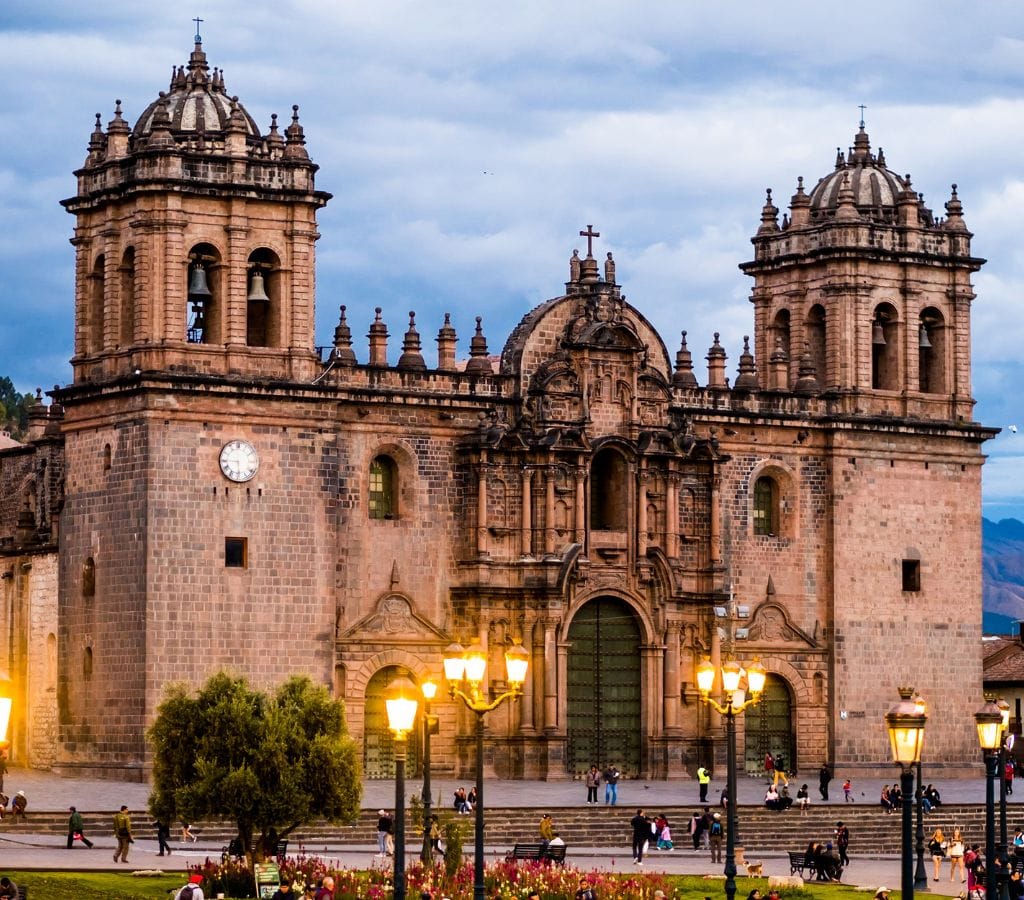
No church dominates the city, historically or visually, like the Catedral del Cusco, towering over the Plaza de Armas. Construction began in 1560 and took nearly a century, built using large stones taken from the nearby fortress of Sacsayhuamán, another symbolic gesture of colonial authority writ in rock.
Inside, the cathedral is an overwhelming display of Andean Baroque opulence—carved cedarwood altars, silverwork, gilded pulpits, and an unrivaled collection of Cusco School paintings, the renowned artistic movement that fused European techniques with Indigenous symbolism.
Among its most famous—and fascinating—works is the painting of the Last Supper by Marcos Zapata. The apostles dine not on bread and wine, but on local Andean dishes, including cuy (guinea pig), a quiet but powerful assertion of Indigenous identity within a Christian framework. Angels wear finely woven Andean garments, the Virgin Mary’s gowns resemble mountain silhouettes, and native flora find their way into Biblical scenes. The message was clear: Christianity was the new doctrine, but the Andean world was not erased—it adapted, encrypted within art.
The cathedral complex also includes two adjacent chapels, Iglesia de Jesús, María y José and El Triunfo, the latter built to commemorate the Spanish victory over Inca resistance. Yet even this triumphalist monument stands on Inca foundations, an unshakeable reminder of civilizations that could not be fully overwritten.
Qorikancha & Santo Domingo: Gold to Gilding
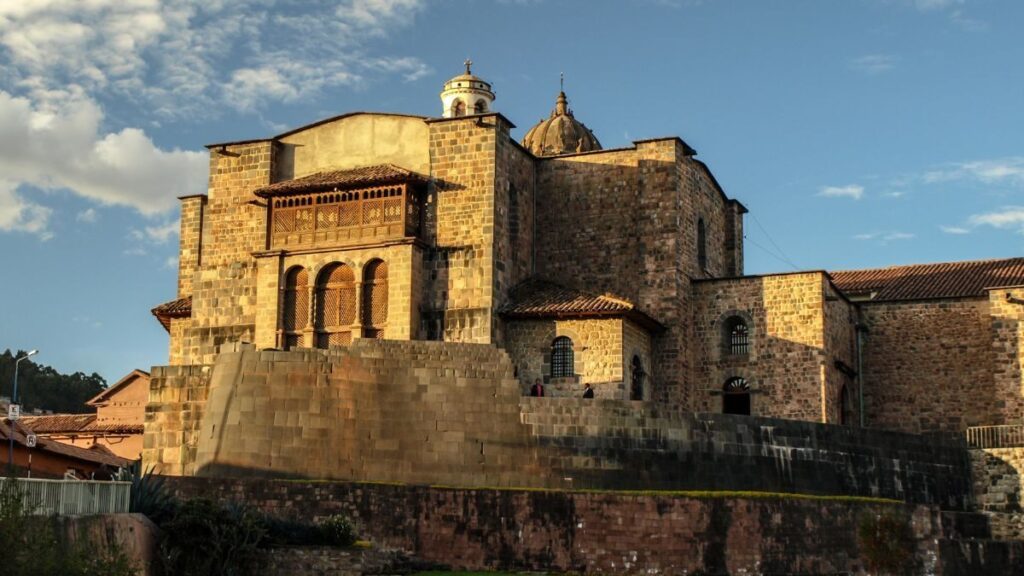
No site better illustrates conversion and contrast than the Temple of Qorikancha (Temple of the Sun), once the most sacred and gold-covered sanctuary in the Inca Empire. Chroniclers claimed its walls were once sheathed in sheets of gold, its courtyard filled with golden statues, and its priests dedicated solely to the sun deity, Inti.
After the conquest, the gold was stripped away, the priests replaced, and atop its immaculate stone walls rose the Convent of Santo Domingo. Today, the lower half remains pure Inca engineering—finely fitted, earthquake-resistant stonework—while the upper structure displays colonial arches and cloisters.
This monument is not just architectural—it is ideological: a visual representation of domination, transformation, and survival. The Incas lost the gold, but their stones endured. Visitors often leave with the unmistakable sensation that while empires changed, the Andean spirit remains rooted beneath the surface.
La Compañía de Jesús: The Jewel of the Plaza
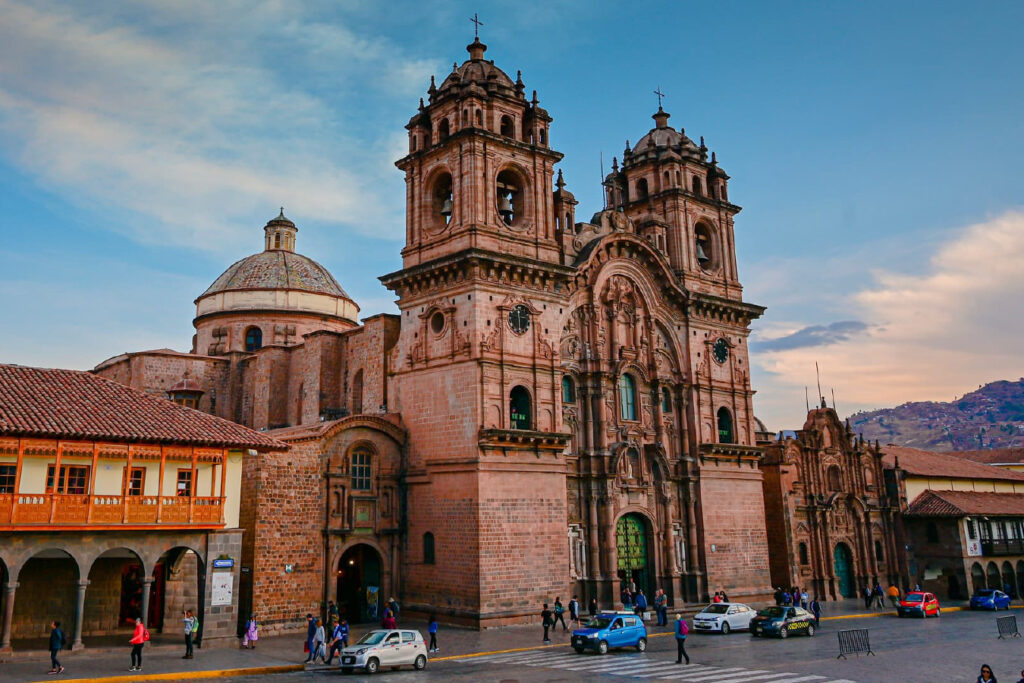
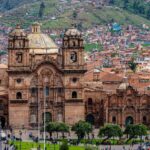
Facing the Cathedral across the Plaza de Armas stands La Compañía de Jesús, the Jesuit church often considered the most exquisite example of Andean Baroque in the entire continent. Completed in 1571 and later rebuilt after the 1650 earthquake, its façade is a masterpiece of carved stone: soaring columns, floral motifs, cherub faces, and Indigenous iconography subtly woven among Christian symbols.
The church’s grandeur once sparked controversy—its splendor rivaled the cathedral itself, angering local clergy who believed no church should overshadow the seat of the archbishop. Inside, the gold-leaf main altar is breathtaking, rising in shimmering tiers, while paintings depict not only Biblical scenes but the spiritual convergence of continents.
La Compañía captures the soul of colonial Cusco: ambitious, dramatic, devout, but also syncretic—where angels might have Andean features and saints reside in landscapes that resemble the high Andes rather than Jerusalem.
San Blas: The Neighborhood, the Pulpit, the Soul
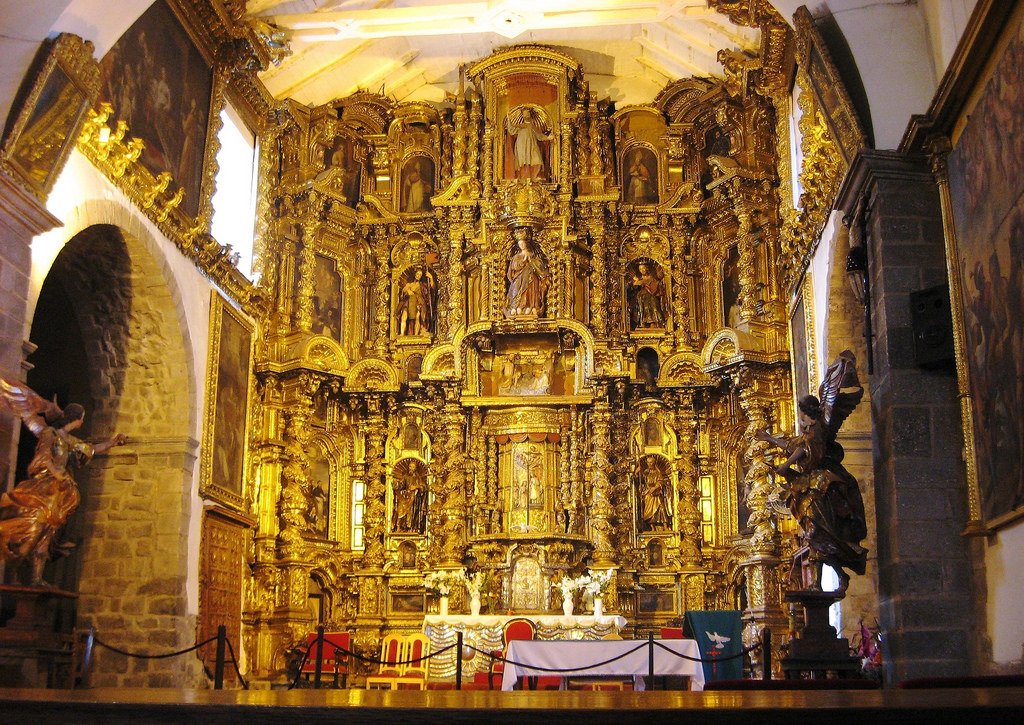
In the bohemian district of San Blas lies the humbler but profoundly revered Iglesia de San Blas, the oldest parish church in Cusco. It was built on another important Inca ceremonial site and served as a center for baptizing Indigenous noble families in the early colonial period.
While the church exterior is modest, inside lies one of Cusco’s greatest artistic treasures: the cedarwood pulpit, carved in the 17th century by master craftsman Juan Tomás Tuyru Túpac, an Indigenous artist. The pulpit is considered one of the finest examples of woodcarving in the Americas—a swirling symphony of saints, tropical fruits, mermaids, angels, and native motifs.
San Blas remains one of Cusco’s most spiritually atmospheric places—quiet, intimate, and filled with artistic reverence rather than grandiose spectacle.
Syncretism: The Third Religion
One cannot fully understand Cusco’s churches without understanding religious syncretism, the blending of Catholicism with Andean beliefs. This fusion was neither complete conversion nor quiet surrender—it was adaptation, resistance, and reinterpretation.
-
The Virgin Mary is often associated with Pachamama (Mother Earth).
-
Holy festivals align with agricultural cycles and seasonal rituals.
-
Saints become guardians of mountains once watched over by Apus.
-
Offerings of flowers, corn, and coca leaves accompany Christian prayers.
In Cusco, faith is plural, layered, and alive. The churches may bear the names of Catholic saints, but the spiritual heartbeat still echoes older, deeper rhythms.
More Than Monuments—Living Churches
Today, Cusco’s churches are not relics frozen in time; they are vibrant centers of devotion. Their bells mark daily life, their doors open to processions, baptisms, weddings, and festivals. During Corpus Christi, entire parishes carry towering saint statues through the streets in an explosion of music, incense, and color—a tradition that blends Spanish pageantry with Andean communal spirit.
Each church, whether grand or humble, tells a story of collision and creation—of conquest and continuity, suppression and survival, loss and reinvention.
Conclusion: The Sacred Tapestry of Cusco
Cusco’s churches are more than architectural wonders; they are sacred archives. Their walls hold the tension of history, their art speaks in coded harmony, and their stones—Inca and colonial—stand inseparable. To explore them is to witness a rare cultural phenomenon where the past was not replaced, but remixed; not silenced, but transformed.
In no other city does gold-stripped temple stone hold a gilded altar above it. In no other place does a Last Supper feature guinea pig. In no other skyline do church bells ring over Inca masonry.
Cusco is not just a city of churches. It is a city where faith was conquered, rewritten, indigenized, and ultimately made eternal—stone by stone, prayer by prayer, fusion by fusion.


Leave A Reply